
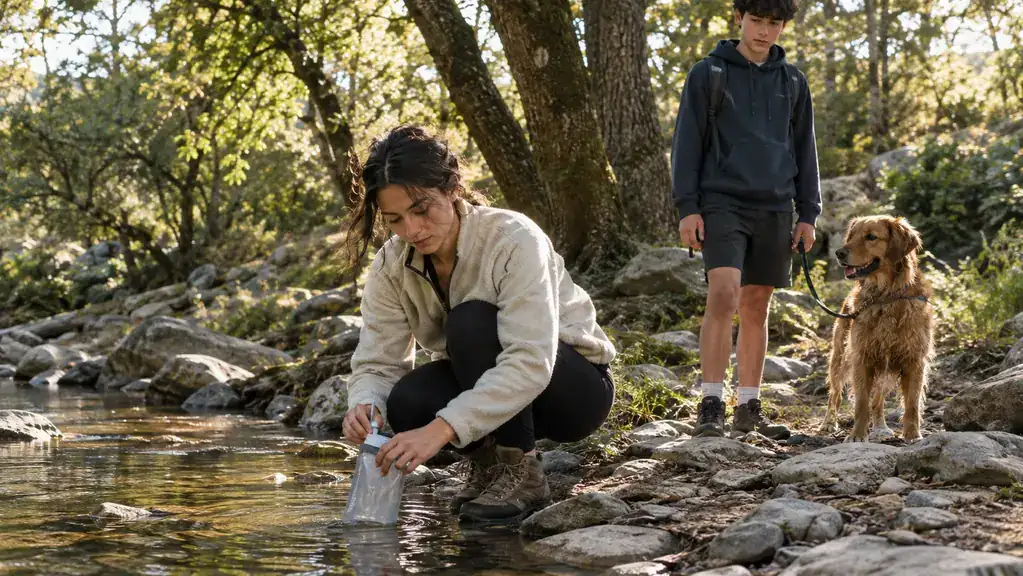
I bought the Sawyer Squeeze about two years ago, right before our first family trip to Colorado. Back then, our system was simple: we hauled every drop of water from the car and rationed it like we were crossing a desert. Caleb drank his share before we hit the trailhead. Wyatt complained his bottle was too heavy. The dogs drank from my cupped hands. It worked, barely, and only because we never went far.
So when I started reading about the Sawyer Squeeze, the promise sounded perfect. Filter water from any creek, lake or stream, no pumping, no batteries, no waiting. Two years later, after weekend trips to Lost Maples, Garner and Padre Island, plus that Colorado trip, I have honest notes. Some of them match the reviews. Some of them I had to learn the hard way.
The Quick Verdict
The Sawyer Squeeze filters water reliably, packs small and never needs batteries. But the flow rate depends on how much effort you are willing to put in, and the cleaning routine is more of a thing than the marketing lets on.
Amazon Check Today's Price →The filter that went two years without failing me
For a family that hikes, camps and carries two flat-faced dogs, the Sawyer Squeeze has earned its spot in the pack. It is not the fastest filter and it is not the laziest one, but it has never once let dirty water through.
Amazon Check Today's Price on Amazon →How I've Used It
Our setup is not fancy. I carry the Sawyer Squeeze in the front pocket of my 4Monster daypack, where I can reach it without taking the pack off. The two squeeze pouches live in the pack's main compartment, and the straw and adapter stay in the mesh pocket, mostly because I lose small things if they do not have a home.
On a typical Texas day hike, I fill one pouch at the last reliable water source and use it for the dogs. Biscuit and Pepper are French bulldogs, so they overheat fast. They need water more often than the rest of us, and they need it in a bowl or a cupped hand, not a bottle. The Sawyer's pouch lets me squeeze water into a collapsible bowl without dunking the bowl in the creek. That alone has been worth the weight.
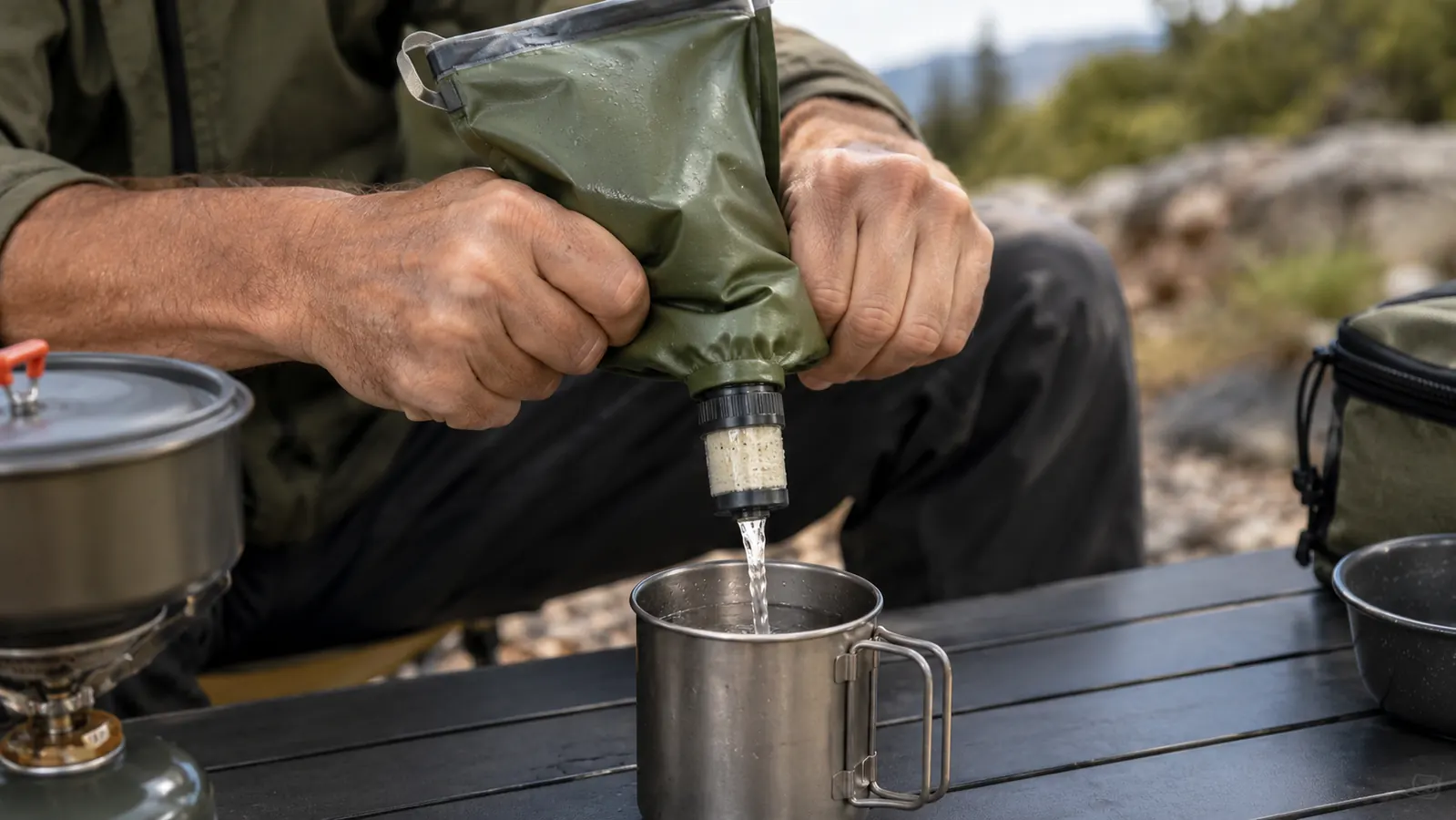
For the humans, I filter into everyone's bottles at the same time. Caleb holds his bottle, I squeeze, and the water runs through the filter. It takes about a minute per liter when the filter is clean. Wyatt thinks this is slow. Wyatt also thinks walking is slow, so I take his complaints with a full water bottle's worth of salt.
The first real test came on that Colorado trip, about a month after I bought the filter. We camped beside a stream that ran straight off the mountain, and I filled the pouch where the water moved fastest. Ray stood there holding the iodine tablets we used to carry, watching me squeeze a full liter into Caleb's bottle in under a minute. He asked me to do his bottle next, then Wyatt's, then his again before bed. By the third morning he was filling the pouch himself and had stopped asking whether the filter was worth the space in the pack. That trip is also where I learned the pouch fills slower than it empties. In shallow water you have to hold it open with one hand and scoop with the other, which looks ridiculous but works. I now fill it using one of our wide-mouth bottles as a scoop, and it cut the fill time roughly in half. Caleb still refuses to use the pouch at all, so I fill his bottle and hand it over. Some battles are not worth fighting at a trailhead.
The Flow Rate, Honestly
Here is what nobody tells you in the product photos: the flow rate is not a fixed number. It is a relationship between how hard you squeeze, how dirty the water is, and how recently you backwashed the filter. On a good day, with clear water and a freshly cleaned filter, I can fill a liter bottle in about a minute. On a bad day, after filtering silty creek water for three days straight, I have stood there squeezing for five minutes and gotten half a liter.
The squeeze pouches matter more than I expected. When they are new, they are easy to compress and the water moves fast. After a season of use, the plastic gets stiffer and the flow slows down. The fix is simple: squeeze harder. The honest version is that your hands get tired, and if you are filtering for four people and two dogs, your hands will get tired a lot.
I learned to filter while the teens were doing something else. If I filtered while they watched, the complaints started. If I filtered while they threw rocks into the creek, the water was done before anyone noticed. Parenting survival. The filter itself was never the bottleneck. My patience was.
For the first few trips I tried to filter into two bottles at once, holding the filter over Caleb's bottle while Wyatt's waited on a log. It went about as well as you would expect. Water sprayed, Wyatt knocked the second bottle over with his foot, and I spent ten minutes doing what should have taken three. The system that finally stuck is boring: one bottle at a time, the filter aimed straight down, the bottle wedged between my knees, both hands on the pouch. On a day I actually timed it, with a clean filter and clear water at Garner, a full liter took fifty-five seconds. I timed it because Wyatt bet me it could not be done in under a minute, and I will take any wager that involves me winning. On the third day of that same trip, after filtering for six people and two dogs, the same liter took closer to two minutes. Same filter, same water. The only difference was how much silt had built up in the fibers since the last backwash.
Cleaning: The Part I Almost Skipped
The Sawyer Squeeze comes with a small syringe for backwashing. The instructions say to backwash after every trip and whenever the flow slows down. I will be honest: I did not backwash after every trip for the first six months. I rinsed the filter, shook it dry and called it good. The flow rate got slower and slower, and I blamed the filter.
Then I actually read the instructions, did a proper backwash, and the filter flowed like new. The lesson was embarrassing and useful: the Sawyer Squeeze does not fail dramatically. It fails gradually, and the gradual failure is your cue to clean it, not to replace it. Now I backwash after every trip, and the flow rate has stayed consistent for over a year.
The first proper backwash happened on a Tuesday night in my kitchen, which is not a glamorous story but it is the true one. I had come home from a weekend at Lost Maples with a filter that had slowed to a trickle, and I was ready to write it off as worn out. I filled the syringe with tap water, attached it to the output side, and pushed. The water that came out the other end was brown. Not creek-water brown. Mud brown. I pushed four full syringes through before it ran clear, and the next weekend the same filter filled a liter bottle in under a minute. That was the moment I stopped blaming the gear and started owning the maintenance. Now the backwash syringe lives in the same zipper bag as the filter, so I cannot pack one without the other. I also learned to backwash before a trip, not after, because a clean filter at the trailhead is worth more than a clean filter in the driveway. Ray watched the whole thing and said nothing, which from him is a compliment.
The cleaning routine takes about five minutes. You fill the syringe with clean water, attach it to the filter's output side, and push water backward through the fibers. Repeat until the water runs clear. Then store the filter with a little moisture in it, never frozen. I keep mine in a zipper bag in the pack so it does not freeze in the car overnight.
The Sawyer Squeeze does not fail dramatically. It fails gradually, and the gradual failure is your cue to clean it, not to replace it.
What It Filters, and What It Does Not
The Sawyer Squeeze filters bacteria and protozoa, which covers the vast majority of what you will meet in a Texas creek or a Colorado stream. It does not filter viruses, and it does not remove dissolved chemicals, heavy metals or salt. For the hiking and camping we do, that is the right tradeoff. For international travel or questionable tap water, it is not.
I also want to be clear about what the filter does not do: it does not make silty water taste like spring water. It makes silty water taste like less silty water. If you filter from a muddy pool because that is the only water source, you will taste the mud. Filtering from moving water, or letting the silt settle in the pouch before you squeeze, helps a lot.
One more limit: the filter can freeze if it is left out overnight in cold weather. Freezing can crack the hollow fibers and ruin the filter. I keep mine in my sleeping bag on cold nights, which is a small habit that protects a piece of gear I do not want to replace.

What I'd Change If I Could
The pouches are the weakest link. They work, but they are fiddly to fill in shallow water, and the caps can be hard to thread when your hands are cold. I have also had the pouches develop a faint plastic taste after a season of use. A quick rinse with warm water and a little baking soda helped, and the taste faded.
I would also love a way to know when the filter needs cleaning without waiting for the flow to slow. The flow slowdown is the signal, but by then you are already standing in the creek squeezing harder than you should. A pressure gauge would be overkill for a filter this light, but I can dream.
And the straw. The included straw works, and the hydration pack adapter works, but I have never used either one on a hike. The squeeze pouches are faster for filling bottles and bowls, and the straw adds a piece to clean and keep track of. I keep it in the pack as a backup and reach for it about once a year.
The first pouch developed a slow leak at the seam about eighteen months in. It was not dramatic. I filled it at a creek crossing near Lost Maples, set it on a rock for a second to adjust my pack, and came back to a damp patch under the seam. The second pouch is still going strong, and Sawyer sells replacement pouches separately, so it was an annoyance more than a disaster. But it taught me to check the seams before I trust a full pouch, and I now keep the pouches inside the pack instead of clipped to the outside where they bounce against trees. That one habit probably added a season to the second pouch's life. I have also learned to wrap the filter in a bandana when it rides in the pack, because the threads on the fittings will scratch a water bottle if they rub against it all day. Wyatt asked if the leak meant we needed a new filter, and I had to explain that the filter was fine, the pouch was the part that wore out. He nodded and went back to skipping rocks. That is about the level of mechanical sympathy I get around here.
What I Liked
- Filters bacteria and protozoa from clear water sources without batteries or pumping
- Weighs almost nothing and tucks into a pack pocket
- A proper backwash brings the flow rate back to new, even after heavy use
- Two pouches included, plus a straw and a hydration pack adapter
Where It Falls Short
- Flow rate depends on your squeeze, and filtering for a family wears out your hands
- Cleaning is a real routine, not an occasional chore
- The pouches get stiffer with use, and one of mine leaked at the seam
- It must never freeze, which means sleeping with it on cold nights
Who This Is For
The Sawyer Squeeze is for hikers and campers who want reliable filtration without carrying a pump or a heavy bottle. It is for families like mine who need to filter water for multiple people and a couple of dogs, and who do not mind spending a few minutes squeezing to save the weight of hauling every drop from the car.
It is also for people who like gear that does one thing well and does not need batteries, cartridges or a charging cable. The Sawyer Squeeze has no electronics, no moving parts and no expiration date on the filter itself. The company says the filter can handle up to 100,000 gallons, which I cannot verify, but I can say that two years of family trips have not worn mine out.
Who Should Skip It
If you want to fill a bottle instantly with zero effort, the Sawyer Squeeze will frustrate you. A gravity filter or a pump will move water faster, at the cost of more weight and more setup. If you are a solo hiker who only needs a liter at a time and wants the fastest possible flow, a squeeze filter with a wider bore might suit you better.
If you are hiking in cold weather and will not commit to keeping the filter from freezing, this is not the filter for you. The freeze risk is real, and a frozen Sawyer Squeeze is a ruined Sawyer Squeeze. And if you need to filter viruses, for international travel or emergency preparedness, you need a different tool entirely.
I would also skip it if you are not willing to backwash. The cleaning routine is simple, but it is a routine. If you want a filter you can ignore between trips, a different design will serve you better.
The Bottom Line
Two years in, the Sawyer Squeeze is still the filter I reach for. It has filtered creek water at Lost Maples, lake water at Garner, tap water at a questionable campground and mountain stream water in Colorado. It has filled water bowls for Biscuit and Pepper, water bottles for Caleb and Wyatt, and coffee water for Ray when he forgot his own bottle. It has never let us down.
It is not the fastest filter, and it is not the laziest one. It is the filter that works, trip after trip, as long as you clean it and keep it from freezing. That is the honest review. That is also, for our family, exactly what we needed.
Still the filter I reach for, two years later
If you want reliable filtration without batteries, pumps or a heavy bottle, the Sawyer Squeeze is worth a spot in your pack. Just backwash it now and then, and keep it from freezing.
Amazon Check Today's Price on Amazon →