
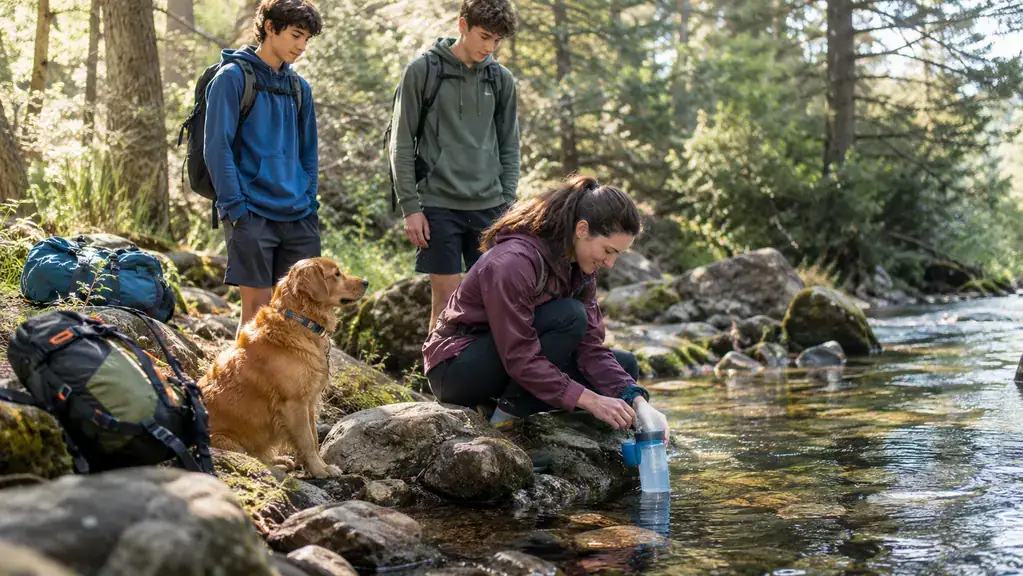
Somewhere around mile three, the packs start feeling heavy. The kids start asking how much farther. The dogs start walking slower, and Biscuit has already parked himself in the shade twice. That is the moment I used to regret every bottle of water I packed.
We used to carry every drop of water in from the car. Two liters per person, plus a liter for each dog, plus extra for cooking and washing. By the time we reached camp, we were hauling ten pounds of water we could have found in the creek we just crossed. Then, before our Colorado trip two years ago, we bought a Sawyer Squeeze, and it changed how we pack for every hike since.
The filter that lives in my daypack now
The Sawyer Squeeze filters creek water fast enough for a family of four plus two dogs, and it weighs almost nothing. We have used ours on weekend trips to Lost Maples and Garner and on a longer trip to the Colorado mountains. It threads onto standard water bottles, which is the reason the kids actually use it.
Amazon Check Today's Price on Amazon →Here is the system we landed on. It is not complicated, and the kids can do most of it themselves. These are the five steps we follow every time we filter water on the trail, plus the things I wish someone had told me before our first trip.
A quick note before the steps: I am not a guide or a ranger, and I do not play one on the trail. This is the routine that works for our family, and it is worth reading the instructions that come with your filter before you trust it with your water.
Step 1: Find the right stretch of creek
Look for moving water, not a still pool. Moving water is less likely to have a film of stuff on top, and it is easier to fill a pouch without stirring up the bottom. We look for a spot where the creek narrows and runs a little faster, usually just above a small drop or a pile of rocks. A good sign is rocks covered in clean, bright moss. A bad sign is foam on the surface or a smell that makes you step back.
Skip water downstream of a trail crossing, a campsite, or anywhere animals have clearly been standing. If the water smells funny or looks like tea, keep walking. On our Colorado trip, we passed two perfectly good-looking pools before we found the stretch we wanted, and the extra ten minutes was worth it.
The one thing I will not do is filter from a puddle or a slow brown pool. If the water is not moving, we move. The filter does a lot, but it is not a reason to drink something that looks like the bottom of a boot print.
Step 2: Fill the dirty pouch without the bottom gunk
The Sawyer Squeeze comes with two 32-ounce squeeze pouches. One is for dirty water. One is for clean. We keep them separate, and the clean one never touches the creek. I marked both of them with a permanent marker the day they arrived, and that small step has saved us more than once. The marker has worn off once, so I redo it at the start of every season.
To fill the dirty pouch, hold it underwater and let it fill from the top. Do not scoop along the bottom. Scooping stirs up sediment, and sediment is what clogs the filter faster than anything else. If the water is shallow, cup your hand under the opening to guide the water in. The pouch fills in about thirty seconds when you hold it right, and it is satisfying to watch.
I also avoid filling right where the kids have been wading. Wyatt stirs up everything within ten feet of him. I send him upstream to fill his own pouch now, which keeps the water clear and keeps him busy.
Step 3: Squeeze it through the filter into a clean bottle
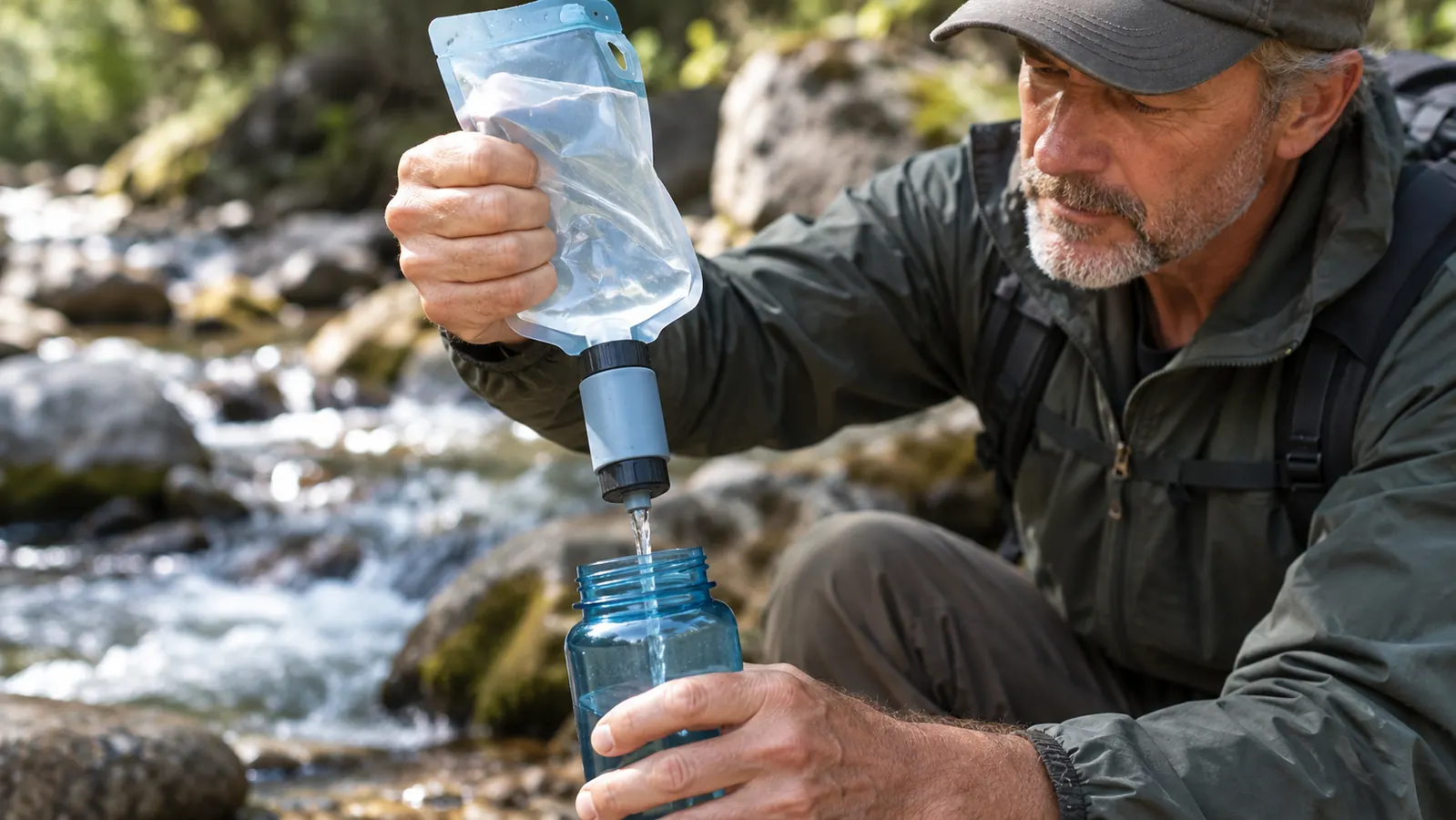
Screw the filter onto the dirty pouch, then screw a clean bottle onto the other side. Squeeze the dirty pouch, and clean water comes out the other end. The Sawyer Squeeze threads onto a standard water bottle, which is half the reason we bought it. No special bottles, no extra parts to lose.
The first few squeezes are the slowest. It speeds up as the filter wets out. I squeeze from the bottom of the pouch, not the middle, so I am not fighting a fold in the plastic. The whole system filters down to 0.1 micron, which is the spec that made me trust it in the first place. On a good day, a full pouch filters in about a minute and a half, which is fast enough that the kids do not lose interest.
The rule at our house is simple: dirty pouch in one hand, filter in the middle, clean bottle on the end. Nobody drinks straight from the creek. Caleb fills his own bottle now, and Wyatt fills his when he remembers, which is about half the time. The other half, he drinks from whoever is closest. We learned that rule the hard way on our first trip, when I handed Wyatt the wrong pouch. Nothing bad happened, but nobody wanted to repeat it.
Step 4: Backflush the filter when it slows down
Backflushing is the maintenance step that keeps the filter working. The Squeeze system comes with a syringe for exactly this. You fill the syringe with clean water, attach it to the filter, and push water backward through it until it runs clear. It takes two minutes, and it makes the next trip feel like a new filter. The syringe lives in the same zipper bag as the filter, so we never have to hunt for it.
I backflush at the end of every trip, not in the middle of one. At home I use tap water. On longer trips I use filtered creek water. I also backflush before the first trip of the season, because the filter has been sitting in the cabinet for a few months.
Store the filter wet. If it freezes, the filter can crack, so in winter it lives in the house, never in the car overnight. That is the one thing I am strict about, because a frozen filter is a ruined filter, and a ruined filter is a trip ruined.
Step 5: Make water a family job
Everyone carries something. Caleb carries the extra dirty pouch. Wyatt carries the clean bottles. I carry the filter and the dog bowl. The dogs drink filtered water too, out of a collapsible bowl, and that saves us from carrying a separate liter just for them. When Biscuit is done walking, he rides in the pack. Pepper lasts longer, but she lets everyone know when she is over it.
We stop at the creek, filter a round, fill everyone's bottle, and keep moving. It takes about ten minutes, less if the kids are not arguing about who filled more. The kids treat it like a job, and honestly, it keeps Wyatt from complaining about his feet for a little while. Caleb races ahead to find the next good crossing, which is fine with me.
The rule that works for us: filter before you are thirsty. If you wait until everyone is cranky, you are filtering while three people stand around staring at you. We filter at the last good source before the trail climbs, and we filter again when we stop for lunch.
Why the Squeeze Instead of a Pump or Drops
Before we bought the Sawyer Squeeze, I looked at pump filters and chemical drops. Pumps work, but they are heavier and slower, and the kids could not use one without making a mess. Drops are light, but they take time, and the dogs would not drink water that tasted like a swimming pool. I still keep drops in the emergency kit, but we have not needed them.
The Sawyer Squeeze sat in the middle. It is light enough to carry, fast enough to use at a rest stop, and simple enough that Caleb figured it out on the first try. Weight matters when you are the one carrying the pack, and the whole setup disappears into the bottom of a daypack.
I also liked that it threads onto standard water bottles. We do not need a special reservoir or a matching set of bottles. Any bottle the kids are already carrying becomes the clean bottle. Fewer parts to lose, fewer things to argue about.
How We Handle Water at Camp
Filtering on the trail is one thing. Camp is another. At Garner, we camp near the Frio, and we filter right at the river before we walk back up to the tent. The Frio is cold even in July, which is half the fun. At Lost Maples, the reliable source is at the trailhead, so we fill there and filter at camp for cooking water and for the dogs.
We keep one dedicated clean bottle for cooking water. It lives in the food bag, and nobody drinks from it. That is the rule Ray enforces, and it is a good one, because nobody wants to cook pasta in water that someone already drank from.
For washing, we use creek water without filtering it. Hands get washed with filtered water, and dishes get a rinse in creek water and a final rinse in filtered water. That is the balance that works for us, and it keeps the filter from working harder than it needs to.
What Else Helps
A second Sawyer Squeeze pouch, or a third, means you can filter more water in one go. We carry two dirty pouches and two clean bottles, which is enough for a full round for everyone. The system also comes with a straw and a hydration pack adapter. We mostly use the squeeze pouches, but the adapter is nice on long days when Caleb wants to drink without stopping.
A wide-mouth bottle on the clean side is easier for kids to fill without spilling. We use the bottles that came with the system, but any standard-mouth bottle works. I also keep a bandana in the pouch with the filter. For really cloudy water, I hold it over the opening of the dirty pouch to catch the big stuff before it reaches the filter.
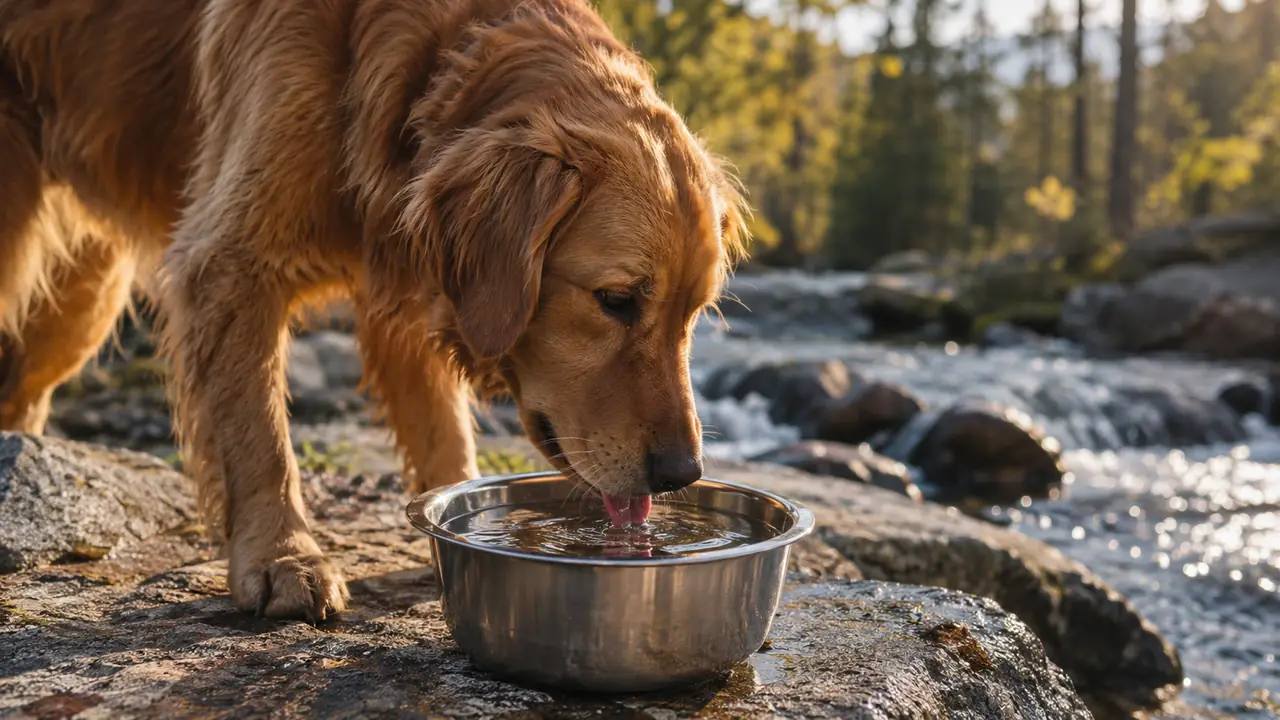
A collapsible dog bowl is the piece I would not skip. Biscuit and Pepper drink filtered water right next to the creek, and the bowl folds flat into my pack when we are done. On hot days, I pour a little water on their necks and chests before we keep going. Flat-faced dogs overheat fast, so water stops are not optional for us.
A small carabiner clips the dirty pouch to the outside of a pack while it dries, so it is not dripping on everything inside. We hang ours from the back of Wyatt's pack, and by lunch it is dry enough to use again.
Ten minutes at the creek beats ten pounds in the pack, every single time. We still carry water in from the car when we camp somewhere without a good source, but on any hike with running water, the filter is the first thing in my pack. The kids know the routine now, and that is the whole point.
Ten minutes at the creek beats ten pounds in the pack, every single time.
Ready to lighten the packs?
The Sawyer Squeeze is the filter we reach for on every family hike. It is small enough to live in the daypack, and it threads onto the bottles the kids already carry. Check today's price on Amazon and see if it fits the way you hike.
Amazon Check Today's Price on Amazon →